

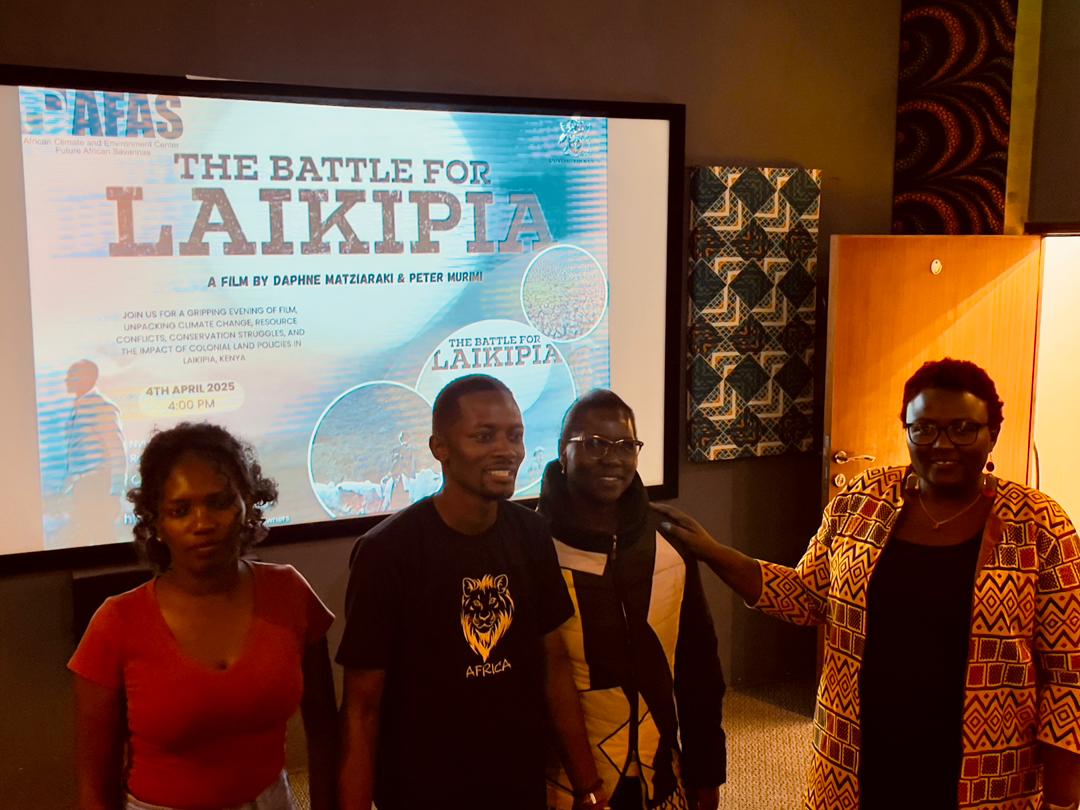
The Battle for Laikipia is a documentary film set in Laikipia County, Kenya. It highlights the complexities of land conflicts between indigenous pastoralist communities such as the Samburu and large-scale landowners that include ranchers and conservancies. Both parties have competing claims on land resources and clashing ethnic claims of place identity, all exacerbated by frequent climatic extremes such as the 2017 drought that was experienced in the area and political tensions that arose in the same election year. It was produced by One Story Up Productions, a company in the United States, directed by Daphne Matziaraki and Peter Murimi and released on 15th June 2024. The documentary is available for public viewing on various platforms globally.
This film is a narrative regarding who belongs, who benefits, and who suffers as a result of both past and present political manipulation and entrenched systems of power conflicting with natural realities. Major highlights in the documentary include climate change and variability, historical land injustices, politicisation and militarisation of ethnic grievances, and conservation versus livelihood needs. These emerging issues are discussed in detail below:
The film exposes the quagmire of land ownership in Laikipia, which is a highly emotive issue, caught between colonial-era land alienation and post-independence land policies. White commercial ranchers control vast portions of land their forebears acquired during the colonial era. Some of these huge tracts of land have also been fenced off as private conservancies, which surrounding local communities have limited or no access to.
On the other hand, there are the semi-nomadic pastoralists, who have long been systematically driven off their land, marginalized, and left landless. Many of these indigenous communities were displaced generations ago and struggle to access grazing land and water resources. This unequal availability of land has built resentment between the two factions over time, especially during dire times like periods of droughts, when the pastoralists move their livestock in search of pasture and water.
Both claim ownership of the land, which begs the question: whose land is Laikipia? The question persists. The film doesn’t give easy answers, and perhaps that is its point. It makes us dwell in the uneasiness of complex realities. As one of the local pastoralist asserts,
“We have always moved across the land in search of water and pasture, but now we are being forced to stay in one place, even when our animals are dying. Why should someone own thousands of acres of land when their neighbour does not have any?”
There is grief on both sides. The families of the white settlers, who themselves were born in Kenya, (Kenyans of European descent), regard this land as their homeland by virtue of inheritance. In one instance, a meeting between one white rancher and some elders from the local community was organised to try and settle a conflict that had occurred the previous night when the pastoralists had breached his fenced-off land in search of pasture and water. In a heated discussion, the rancher boldly claims, much to the chagrin of the locals,
“You steal from us all the time…this is our land, not yours” [translated]
The indigenous pastoralist commune bears the brunt of the ongoing conflicts and challenges related to resource access and land ownership, including evictions and struggles for grazing land and water. In one extreme case, the conflicts resulted in death when in a retaliatory move, some ranchers set fire to a local commune to forcefully evict them and one elderly man was burnt to death in his house. The situation forces them out of their nomadic norms into a more sedentary lifestyle which does not suit them as it means an increased pressure on the land, grass fields and associated ecological distresses.
Conversely, the ranchers are also affected by these increasing conflicts. They have become targets for invasions and attacks by local insurrectionists who deem them as ‘foreigners’. As stewards of the land they inherited from their forefathers, they feel besieged and alienated in a land they legally have a claim to. This leads them to fortify their lands through fencing off and ensuring that the local pastoralists are not welcome. In some instances, they have also been forced to adopt militarised responses such as keeping armed security guards on their perimeter in an effort to ward off any local invaders.
The state, best positioned to be a mediator, has failed woefully, ignoring demands to reform land ownership, providing immunity from prosecution & persecution, and only acting in response to an outbreak of violence. The political class has also been implicated in incitements, usually during the electioneering periods, that have led to the destruction of property and loss of lives. Historical injustices don’t just fade with time, instead, they calcify when unaddressed. The pain festers, generation after generation, until it explodes just as it does in Laikipia. It is essential to recognize that no one is left unscathed, even though the historical burden is not symmetrical. To some extent, power, legal frameworks, and means of access to capital benefited one and disenfranchised the other.
Yet, there’s also a glimmer of possibility and perhaps room for dialogue if both sides can recognize their shared vulnerability. All this depends on the state’s leadership and a willingness to confront uncomfortable histories.
Colonial policies established a system that excluded local African communities from accessing land, resulting in enduring mistrust and conflicts (Shanguhyia & Koster, 2014). In Laikipia, these conflicts manifest primarily between the pastoralist communities and ranchers, including both foreigners and Kenyan-born individuals of European descent (Fox, 2018). Colonial injustices and resource scarcity, exacerbated by climate change, significantly contribute to the ongoing land conflicts in Laikipia County, Kenya, where the landscape is experiencing increased drying and warming, with droughts becoming more intense and frequent, turning the region into a “battleground” (Fox, 2018). Unprecedented pressure on land and water resources is reshaping access and control (Bond, 2014). For pastoralist communities, the consequences are especially dire as their nomadic way of life depends on open access to grazing lands and water. As one pastoralist explains,
“…we have migrated for centuries, following the rains and the grass.”
However, climate change has also led to these vital resources becoming increasingly commodified, fenced off, or depleted. For the white ranchers, increasing temperatures and erratic rainfall patterns have created instability in the balance between conservation, livestock production, and land management. Also, as land becomes drier, it becomes less productive, which affects their livelihoods and ability to maintain wildlife conservation. The land becomes more vulnerable to desertification, and their claim on land, which is already politically sensitive, becomes more uncertain.
In areas where land disputes already exist, the rarity of resources makes conflict nearly inevitable. Climate change, then, is not a distant threat. It’s a lived, daily crisis that sharpens inequalities and forces people into desperate decisions, like moving cattle into private conservancies or protected areas, escalating tensions even further. These tensions manifest as conflicts between pastoralists and various landowners, including foreigners and Kenyans of European descent (Fox, 2018). These conflicts are a volatile mix that extends beyond resource competition, impacting multiple aspects of human security, including economic, food, environmental, and political security (Bond, 2014). The bricolage surrounding the changes in land tenure continues to force the nomadic community into a more sedentary lifestyle. In addition, the proclamations of collapse of the practices of pastoralism come out in the film just as highlighted by many studies and even though this way of life has changed over time, it remains resilient, persisting through cycles of collapse and recovery, especially influenced by climate change and variability (Agrawal & Saberwal, 2016; Scoones et al., 2020).
In conclusion, this film is a glimpse into the inevitable effects of climate change on resources, livelihoods and the people. It highlights the complexities of environmental degradation in the context of the pre-existing social and political issues, such as land ownership. This documentary serves as a harsh reminder that there are no straightforward solutions. The African Climate and Environmental Centre – Future African Savannas (AFAS), which, among other things, strives for interdisciplinary exchange and the science-policy-practice interface for climate change adaptation, could not be more suited to speak on such matters. In light of the realities of this film, both present and future scholars are called to approach climate change mitigation and adaptation in contemplation of the pre-existing social and political issues. These strategies must not only be sustainable but also just, equitable and fair.
References
Arun Agrawal and Vasant K. Saberwal. (2016). Van Gujjar : The Persistent Forest Pastoralists Author ( s ): Perniile Gooch Source : Nomadic Peoples , New Series , Vol . 8 , No . 2 , Special Issue : Whither South Asian Published by : White Horse Press Stable URL : http://www.jstor.org/stable/43123728. 8(2), 125–135.
Bond, J. (2014a). A holistic approach to natural resource conflict: The case of Laikipia County, Kenya. Journal of Rural Studies, 34, 117–127. https://doi.org/10.1016/j.jrurstud.2014.01.008
Bond, J. (2014b). Conflict, Development and Security at the Agro-Pastoral-Wildlife Nexus: A Case of Laikipia County, Kenya. Journal of Development Studies, 50(7), 991–1008. https://doi.org/10.1080/00220388.2014.909025
Fox, G. R. (2018). Maasai group ranches, minority landowners, and the political landscape of Laikipia County, Kenya. Journal of Eastern African Studies, 12(3), 473–493. https://doi.org/10.1080/17531055.2018.1471289
Scoones, I., Stirling, A., Abrol, D., Atela, J., Charli-Joseph, L., Eakin, H., Ely, A., Olsson, P., Pereira, L., Priya, R., van Zwanenberg, P., & Yang, L. (2020). Transformations to sustainability: combining structural, systemic and enabling approaches. Current Opinion in Environmental Sustainability, 42, 65–75. https://doi.org/10.1016/j.cosust.2019.12.004
Shanguhyia, M., & Koster, M. (2014). Land and Conflict in Kenya’s Rift Valley: Historical and Contemporary Perspectives (pp. 191–223). https://doi.org/10.1057/9781137444134_9
Information about the authors:
Elvis Ogot is an AFAS Scholar of the 2nd master Cohort based at the University of Nairobi in Kenya (solvis[at]students.uonbi.ac.ke)
Ann Njuguna is an AFAS Scholar of the 2nd master Cohort based at the University of Nairobi in Kenya (njugunaa.ann[at]students.uonbi.ac.ke)
Annet Margaret Nabirye is an AFAS Scholar of the 2nd master Cohort based at the University of Nairobi in Kenya (annetmargaret[at]students.uonbi.ac.ke)
Chepchumba Cheserek is an AFAS Scholar of the 2nd master Cohort based at the University of Nairobi in Kenya (chepchumba-cheserek[at]students.uonbi.ac.ke)